

The gold price surge has pushed precious metals into the spotlight as retail investors look for stability in a volatile global market. Gold’s relentless ascent, pushing past the $5,000 per ounce mark and reaching an intraday high of $5,595 in early 2026, has captured attention around the world. This is not merely a speculative bubble. Instead, it reflects deeper shifts in the global economic and geopolitical landscape. Understanding these drivers is crucial for any retail investor trying to make sense of gold’s enduring appeal. At Everyday Gold Guide, we cut through the noise to explain what is propelling gold’s historic rise and how it may affect your financial strategy.
For investors who are still building their foundation, our internal guide on gold investing basics explains how gold fits into a broader portfolio. You may also find our guide on precious metals risk management useful if you want to understand position sizing, diversification, and market timing before buying gold-related assets.
Gold Price Surge and the Market Forces Behind It
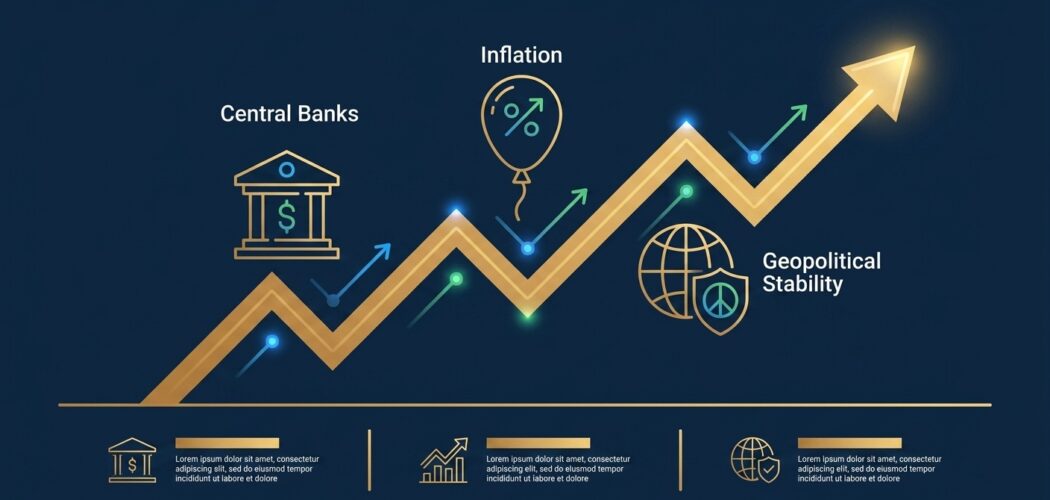
Gold’s current valuation is supported by several powerful factors working together. Central bank demand, currency weakness, inflation concerns, and geopolitical instability have all helped create a strong environment for gold. As a result, retail investors are paying closer attention to gold not only as a short-term trade, but also as a long-term defensive asset.
One of the biggest forces behind the gold price surge is central bank buying. Global central banks, particularly in emerging markets such as China, India, and Turkey, have been increasing their gold reserves. This move is often tied to a desire to diversify away from the U.S. dollar and reduce exposure to sanction-related risks. In Q1 2026 alone, central banks added a net 244 tonnes of gold to their reserves, a 17% increase from the previous quarter. This consistent institutional demand can provide a stronger floor for gold prices during uncertain periods.
The U.S. dollar also plays a major role. A weakening dollar makes gold more attractive to international investors because it becomes cheaper to purchase in other currencies. In addition, the growing U.S. national debt raises long-term questions about confidence in the dollar. Therefore, some investors may shift more capital toward gold as an alternative store of value. For wider market context, investors can review gold research from the World Gold Council and futures market information from CME Group.
Inflation remains another important driver. Even when central banks try to control rising prices, many investors continue to worry about the long-term purchasing power of fiat currencies. Gold has a long-standing reputation as a hedge against inflation because it is viewed as a tangible asset that cannot be printed like paper money. This protective quality continues to attract investors who want shelter from economic erosion.
Geopolitical tension adds even more support. When global instability rises, investors often seek assets they believe can hold value during uncertain times. Gold’s historical role as a safe-haven asset makes it attractive when confidence weakens, markets turn volatile, or political risk increases. Therefore, the gold price surge reflects more than chart momentum. It reflects a wider search for security.
Analyst Forecasts for the Historic Gold Market
Major financial institutions have remained broadly optimistic about gold’s trajectory. Goldman Sachs has maintained a constructive view, reaffirming a price target of $5,400 per troy ounce by the end of 2026, with potential movement toward $5,500 to $6,000 by late 2026 or into 2027. These forecasts suggest that institutional investors still see room for further strength if current market conditions continue.
J.P. Morgan has also projected strong upside potential, with gold prices possibly reaching $6,000 to $6,300 per troy ounce by the end of 2026. The firm has also projected average prices near $5,055 per ounce by the final quarter of 2026, rising toward $5,400 per ounce by the end of 2027. Although forecasts can change, they show how seriously major banks are treating gold’s current momentum.
UBS and Morgan Stanley have also shared constructive views on gold, though with different price expectations and timelines. UBS has forecast higher prices and is among the major banks projecting gold could reach the $5,500 to $6,000 range by 2026 or 2027. Morgan Stanley expected gold prices to stabilize around $2,700 in Q1 2025 and later projected that prices could climb toward $4,800 by Q4 2026.
These forecasts do not guarantee future performance. However, they reinforce the idea that the gold price surge is tied to more than short-term speculation. Central bank demand, currency concerns, inflation pressure, and safe-haven buying all support the broader bullish case for gold.
What the Gold Price Surge Means for Retail Investors
For retail investors, the current gold market highlights the importance of having a clear strategy. Gold can play a valuable role in a diversified portfolio, but it should not be treated as a guaranteed profit opportunity. Prices can rise quickly, yet they can also pull back sharply when the dollar strengthens, interest rate expectations shift, or investors take profits.
Retail investors may consider gold through physical bullion, gold ETFs, mining stocks, or other gold-linked assets. Each option has different risks. Physical gold offers direct ownership, but it may involve storage and insurance costs. Gold ETFs can provide easier access and liquidity, while mining stocks may offer upside but also carry company-specific risks. Because of these differences, investors should choose the method that fits their goals, risk tolerance, and time horizon.
The gold price surge also reminds investors to avoid emotional buying. When headlines become dramatic, many people enter the market late. A more disciplined approach is to understand why gold is moving, decide how much exposure makes sense, and avoid overconcentration. Gold can strengthen a portfolio, but it should still be balanced with other assets.
For long-term investors, gold may offer stability during uncertain periods. For active traders, it may offer opportunities during breakouts, pullbacks, or periods of strong momentum. However, both groups need risk management. No asset moves in a straight line, and gold is no exception.
Conclusion
The gold price surge beyond $5,000 an ounce is being driven by a powerful mix of central bank demand, inflation concerns, geopolitical uncertainty, and weakness in the U.S. dollar. These forces have created a compelling case for gold’s continued relevance in modern portfolios. However, investors should approach the market with discipline rather than excitement alone.
Gold remains one of the world’s most trusted stores of value, but smart investing still requires patience, research, and proper risk control. Whether you choose physical bullion, ETFs, or mining stocks, the key is to understand how gold fits your broader financial plan. Everyday Gold Guide helps retail investors make sense of these market shifts so they can make informed decisions and use gold more strategically.
FAQ
1. What Is Causing the Recent Rise in Gold Prices?
The recent rise in gold prices is being driven by several factors, including central bank buying, inflation concerns, currency weakness, and geopolitical uncertainty. These forces can increase demand for gold because many investors view it as a defensive asset during unstable periods.
2. Why Do Central Banks Buy Gold?
Central banks buy gold to diversify their reserves, reduce reliance on a single currency, and strengthen financial stability. In uncertain global conditions, gold can help central banks manage currency risk and protect long-term reserve value.
3. Is Gold Still a Good Investment for Retail Investors?
Gold can be useful for retail investors who want diversification and protection against market uncertainty. However, it should not be treated as a guaranteed profit source. Investors should consider their goals, risk tolerance, and overall portfolio before buying gold.
4. What Is the Best Way to Invest in Gold?
The best method depends on the investor’s needs. Physical bullion offers direct ownership, gold ETFs provide easier access and liquidity, and mining stocks may offer growth potential with added company risk. Each choice has advantages and drawbacks.
5. Can Gold Prices Fall After a Major Rally?
Yes, gold prices can fall after a strong rally. Pullbacks may happen when the U.S. dollar strengthens, interest rate expectations change, investors take profits, or market fear declines. That is why risk management remains important even during a bullish gold market.