

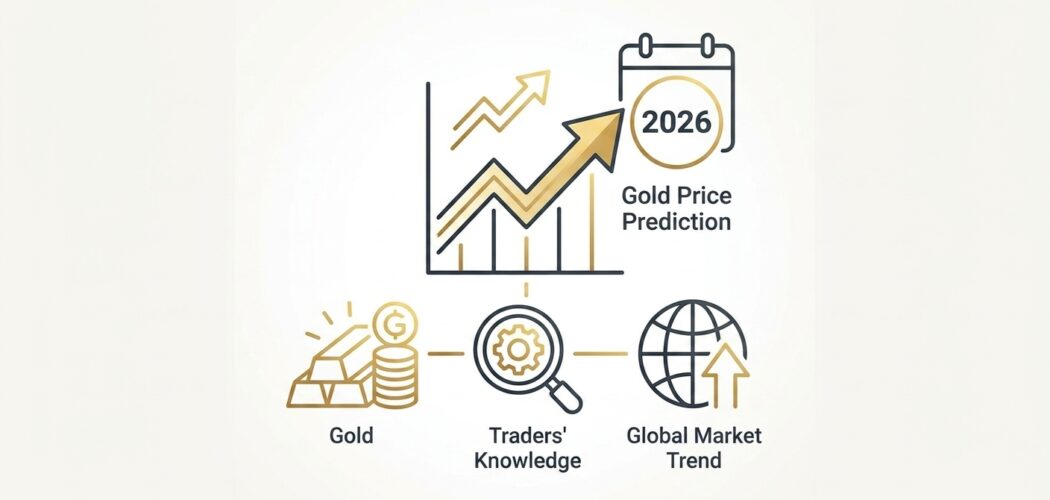
The gold price prediction for 2026 has become one of the biggest talking points for retail investors, especially as gold continues to attract attention during inflation pressure, geopolitical uncertainty, and shifting central bank policy. Many everyday traders want to know whether gold still has room to climb, whether recent volatility creates buying opportunities, and how this precious metal fits into a long-term portfolio. At Gold Price Trader, the goal is to make these market signals easier to understand so investors can make informed decisions without getting lost in confusing financial jargon.
Gold has already delivered a remarkable performance in recent years, and the focus is now firmly on what 2026 may bring. Major financial institutions remain broadly optimistic, with many expecting gold to stay supported by persistent inflation concerns, possible Federal Reserve rate cuts, strong central bank buying, and global instability. However, even a bullish outlook does not mean prices will move in a straight line. Gold can be powerful, but it can also be volatile. That is why investors need a balanced view before making decisions.
For readers who are still building a foundation, our internal guide on gold investing basics explains how gold works as a long-term asset. You may also want to read our guide on inflation hedge investing to understand how gold may protect purchasing power during uncertain economic periods.
Gold Price Prediction and the 2026 Market Outlook
A clear gold price prediction starts with understanding what major analysts expect. In 2026, many leading institutions have projected higher gold prices, although their exact targets vary. J.P. Morgan Global Research has suggested that gold could potentially move toward the $6,000 to $6,300 per troy ounce range by the end of 2026. While the firm adjusted its average forecast in May 2026 due to softer near-term investor demand, it still expected strong recovery potential later in the year.
Goldman Sachs has also maintained a constructive view, with a price target near $5,400 per troy ounce by the end of 2026. In more intense geopolitical or de-dollarisation scenarios, its upside range has been projected even higher. Bank of America has also shared a strong outlook, setting an ambitious 12-month target near $6,000 per ounce. UBS has projected a base case near $5,900, with an upside scenario around $6,200.
Other institutions have offered slightly more conservative but still positive forecasts. Morgan Stanley has revised its 2026 gold forecast upward, while Deutsche Bank has suggested gold could continue climbing under supportive market conditions. As a result, the general outlook from major analysts remains positive, with many forecasts clustering between the upper $4,000s and mid-$5,000s on an annual average basis.
These projections are not guarantees. Forecasts can change quickly when inflation data, central bank decisions, currency trends, or geopolitical events shift. However, the shared bullish tone across major institutions suggests that gold’s strength is not based only on short-term excitement. Instead, it reflects deeper market forces that continue to support demand.
Investors can also review broader market research from the World Gold Council and gold futures information from CME Group. These outbound resources help investors better understand global gold demand, futures pricing, and the wider market structure behind gold trading.
Why Gold Could Stay Strong in 2026
A strong gold price prediction depends on several connected forces. One of the most important is inflation. Gold has a long history as a hedge against inflation because it is a tangible asset that cannot be printed like paper currency. When investors worry that cash is losing purchasing power, gold often becomes more attractive. This is especially important for retail investors who want to protect long-term savings from rising costs.
Interest rates also matter. Gold does not pay interest, so it can face pressure when bond yields rise. However, the relationship changes when inflation remains high and real interest rates stay low. If investors earn weak real returns from cash or bonds, gold can become more appealing. In 2026, markets have been watching closely for possible Federal Reserve rate cuts. If rate cuts happen while inflation remains a concern, gold may benefit from that environment.
Geopolitical uncertainty is another major driver. When global tensions rise, investors often look for safe-haven assets. Gold has a long record of attracting demand during periods of conflict, financial stress, or uncertainty. Events involving the Middle East, trade disruptions, shipping lane concerns, or energy price shocks can all increase demand for gold. While these risks are difficult to predict, they can quickly influence investor sentiment.
Central bank demand is also a powerful structural force. In recent years, central banks around the world have increased gold purchases as part of their reserve diversification strategies. Many central banks, especially in emerging markets, want to reduce reliance on the U.S. dollar and hold more assets viewed as long-term stores of value. This steady demand can help support gold prices, even when short-term traders take profits.
The U.S. dollar remains a key factor as well. Gold is priced globally in dollars, so a weaker dollar often makes gold cheaper for international buyers. That can increase demand and support prices. On the other hand, a stronger dollar may put pressure on gold. Retail investors should watch dollar trends closely because they often influence gold’s short-term direction.
A useful gold price prediction should also account for investor psychology. When gold rises sharply, more investors pay attention. However, this can lead to emotional buying near short-term highs. Smart investors look beyond headlines and ask whether the move is supported by inflation, rates, central bank demand, and currency trends. That broader view helps reduce the risk of chasing prices.
Recent Gold Performance and Market Volatility
Gold’s recent performance has been impressive, but it has not been smooth. After strong gains in 2025, gold became one of the most closely watched assets in global markets. Demand from central banks, exchange traded funds, and investors helped drive prices higher. This momentum continued into early 2026, when gold reached fresh highs before pulling back.
That pullback is important because it reminds investors that gold is not risk-free. Even in a bullish trend, prices can fall quickly when traders take profits, the dollar strengthens, or expectations around interest rates shift. For retail investors, these corrections can feel unsettling. However, they may also create more attractive entry points when the longer-term drivers remain supportive.
Volatility can create opportunity, but only for investors with a plan. Buying gold only because prices are rising can lead to poor timing. Instead, investors should think about why they are buying, how long they plan to hold, and how much of their portfolio should be exposed to gold. A clear plan can help prevent emotional decisions during sharp market swings.
For active traders, gold volatility can create setups around support, resistance, breakouts, and pullbacks. For long-term investors, volatility may be less important than the broader role gold plays in diversification. Either way, risk control matters. Gold can protect against some economic risks, but it should not dominate an entire portfolio.
This is where practical strategy becomes important. Investors should avoid putting all their money into gold because of one forecast or one dramatic headline. A balanced allocation can help gold support the portfolio without creating too much concentration risk. Many investors use gold as one part of a wider plan that may include stocks, bonds, cash, and other hard assets.
Practical Gold Strategies for Everyday Investors
A useful gold price prediction should lead to practical action, not just speculation. For beginners, the first step is choosing the right investment method. Physical gold, such as bars and coins, offers direct ownership. It can be useful for long-term wealth preservation, but it also requires safe storage and may involve insurance costs. Investors who value tangible assets may prefer this option.
Gold exchange traded funds can be easier for many retail investors. ETFs provide exposure to gold through a brokerage account, without the need to store physical metal. They can also be bought and sold more easily than bars or coins. However, investors should review fees, fund structure, and whether the ETF holds physical gold or tracks gold-related instruments.
Gold mining stocks offer another route, but they come with added risks. Mining companies may benefit when gold prices rise, yet their performance also depends on operating costs, debt, management quality, and production issues. A gold miner is not the same as physical gold. Therefore, investors should research mining companies carefully before buying.
Gold IRAs may appeal to investors focused on retirement planning. These accounts can allow eligible investors to hold physical gold inside a tax-advantaged structure. However, fees, rules, custodians, and storage requirements vary. Investors should review the details carefully before choosing this path.
Digital gold has also become more accessible. Some platforms allow investors to buy small amounts of gold through mobile apps or online accounts. This can lower the barrier to entry, although investors should still check platform credibility, fees, liquidity, and ownership terms.
For traders seeking short-term exposure, products such as gold contracts for difference may offer flexibility. However, these instruments can involve leverage and higher risk. Beginners should be especially careful because leveraged products can magnify losses. A small price move in gold may create a much larger gain or loss in a leveraged account.
A balanced strategy often works best. Many financial advisors suggest that gold should represent only a modest portion of a diversified portfolio. For some investors, that might mean 5% to 10%, depending on their goals and risk tolerance. This type of allocation may help protect against inflation and uncertainty without overexposing the portfolio to one asset class.
Investors should also think about time horizon. Gold may work best as a long-term store of value when held through different market cycles. Short-term traders, however, need a more active plan with entry levels, stop-loss rules, and profit targets. The right approach depends on whether the investor wants protection, growth, trading opportunities, or a mix of all three.
How to Use Forecasts Without Overreacting
The biggest mistake investors make with any gold price prediction is treating it as certainty. Forecasts are useful because they show how analysts view market conditions. However, they should not replace personal research or risk management. Even respected institutions can adjust their targets when new data changes the outlook.
Retail investors should use forecasts as guideposts, not instructions. If several institutions expect gold to rise, that can support a bullish view. Still, investors should ask what could go wrong. A stronger U.S. dollar, lower inflation, rising real yields, reduced central bank demand, or improving global confidence could all pressure gold prices.
This balanced mindset helps investors avoid emotional decisions. When forecasts are very optimistic, excitement can lead to overbuying. When gold pulls back, fear can lead to selling too soon. A practical investor uses forecasts alongside market data, portfolio goals, and risk limits.
Gold can play an important role in a modern portfolio, especially when uncertainty is high. However, it should be used thoughtfully. The goal is not to predict every price movement perfectly. Instead, the goal is to understand the main forces behind gold, choose suitable investment options, and stay disciplined through volatility.
Conclusion
The gold price prediction for 2026 remains broadly bullish, supported by inflation concerns, possible central bank easing, geopolitical uncertainty, central bank demand, and the U.S. dollar’s influence. Major financial institutions continue to see meaningful upside potential, although their exact targets vary. For retail investors, this creates both opportunity and responsibility.
Gold can be a reliable store of value, a potential inflation hedge, and a useful safe-haven asset during uncertain times. However, it is not a guaranteed winner, and it can still experience sharp pullbacks. The smartest approach is to combine market awareness with a balanced strategy, careful position sizing, and a clear understanding of the investment method being used.
At Gold Price Trader, we believe informed investors make better decisions. Whether you choose physical gold, ETFs, mining stocks, digital gold, or retirement-focused options, gold should fit your wider financial plan. By staying patient, avoiding hype, and focusing on long-term resilience, retail investors can approach the 2026 gold market with greater confidence.
FAQ
1. What Is the Main Forecast for Gold in 2026?
Many analysts expect gold to remain strong in 2026 because of inflation pressure, possible rate cuts, central bank demand, and geopolitical uncertainty. However, forecasts vary, and investors should treat them as guidance rather than guarantees.
2. Why Do Investors Use Gold as an Inflation Hedge?
Investors often use gold as an inflation hedge because it is a tangible asset and cannot be printed like fiat currency. When the value of paper money weakens, gold may help preserve purchasing power over time.
3. Can Gold Prices Fall Even During a Bullish Market?
Yes, gold prices can fall even when the long-term outlook is positive. Pullbacks may happen when the dollar strengthens, investors take profits, or interest rate expectations change. That is why risk management is important.
4. What Is the Easiest Way for Beginners to Invest in Gold?
Gold ETFs are often one of the easiest options because they can be bought through a brokerage account and do not require physical storage. However, beginners should still review fees, risks, and fund structure before investing.
5. How Much Gold Should Retail Investors Hold?
The right allocation depends on personal goals, risk tolerance, and portfolio size. Some investors use a modest 5% to 10% allocation, but each person should choose an amount that fits their broader financial plan.