

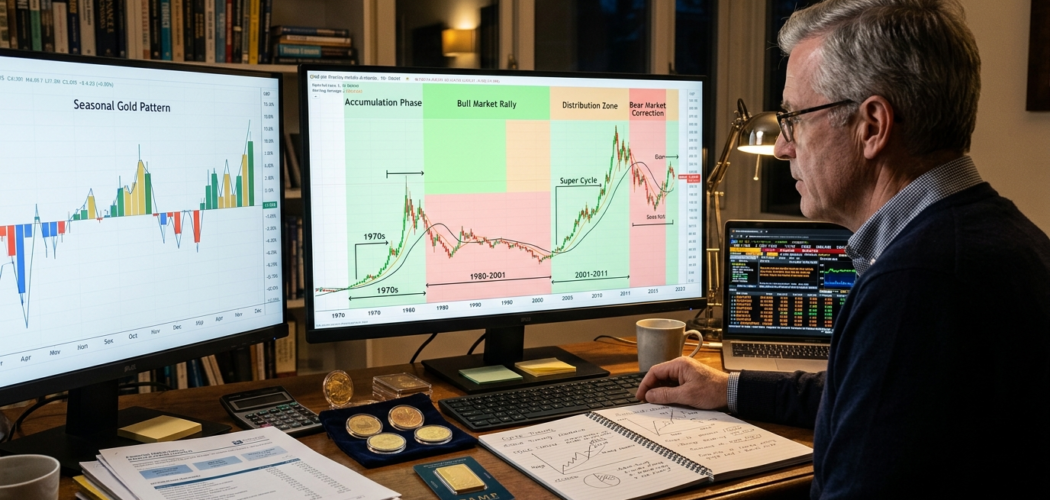
Gold has long been considered a reliable store of value, but its price movements are far from random. Instead, they follow recognizable patterns influenced by economic forces, investor behavior, and global events. By understanding these patterns, investors can improve their ability to act at the right moment. This is where gold cycles trading timing becomes essential, as it helps traders identify when to enter or exit positions with greater confidence.
Many investors make the mistake of reacting to price changes rather than anticipating them. However, markets tend to move in cycles, and those cycles provide valuable signals. When you learn how to interpret them, you gain a strategic advantage. Gold cycles trading timing is not about predicting exact price points, but rather about recognizing trends and positioning yourself accordingly.
What Drives Gold Market Cycles
Gold cycles are influenced by several key factors, including inflation, interest rates, currency strength, and economic stability. These forces interact in ways that create repeating patterns over time. While no cycle is identical, many share similar characteristics that investors can learn to recognize.
For example, during periods of economic uncertainty, gold demand tends to increase. Investors seek safety, which pushes prices higher. Conversely, during strong economic growth, demand may weaken as capital flows into riskier assets. These shifts form the basis of gold cycles trading timing.
Additionally, central bank policies play a major role. Changes in interest rates and monetary policy often signal the beginning or end of a cycle. By monitoring these factors, investors can better anticipate market movements and align their strategies accordingly.
Recognizing The Phases Of A Gold Cycle
Every gold cycle typically moves through distinct phases. Understanding these stages is critical for effective gold cycles trading timing. While the duration of each phase may vary, the overall pattern remains consistent.
The first phase is accumulation. During this stage, prices are relatively low, and investor interest is limited. However, experienced investors begin to build positions quietly. This phase often occurs when sentiment is weak, making it an ideal time for strategic buying.
Next comes the uptrend phase. As economic conditions shift or uncertainty rises, demand for gold increases. Prices begin to climb, attracting more attention. Momentum builds, and more investors enter the market.
The third phase is the peak. At this point, optimism is high, and gold prices may reach elevated levels. While this can be a profitable time, it also signals potential risk. Many investors enter late, driven by fear of missing out.
Finally, the cycle moves into the decline phase. Prices begin to fall as demand decreases. Sentiment shifts, and weaker hands exit the market. This phase eventually leads back to accumulation, completing the cycle.
Recognizing these phases allows investors to apply gold cycles trading timing more effectively.
Using Historical Patterns To Improve Timing
Historical data provides valuable insights into gold cycles. By studying past trends, investors can identify recurring patterns and apply them to current market conditions. This approach enhances gold cycles trading timing by adding context to price movements.
For instance, gold often performs well during periods of economic instability or rising inflation. By comparing current conditions with historical scenarios, investors can anticipate potential outcomes. While history does not repeat exactly, it often rhymes.
Charts and long-term price trends also reveal important patterns. These include cyclical highs and lows, which can guide entry and exit decisions. By combining historical analysis with current data, investors create a more informed strategy.
The Role Of Market Sentiment In Cycles
Market sentiment plays a crucial role in shaping gold cycles. It reflects how investors feel about the economy and influences their decisions. Understanding sentiment enhances gold cycles trading timing by revealing emotional extremes.
During the accumulation phase, sentiment is often negative. Few investors are interested in gold, and prices remain low. However, this is when opportunities begin to emerge. As sentiment improves, the uptrend phase gains momentum.
At the peak, sentiment becomes overly positive. Many investors enter the market, pushing prices higher. However, this optimism often signals that the cycle is nearing its end. Recognizing these emotional shifts helps investors avoid costly mistakes.
By aligning sentiment analysis with cycle phases, you gain a deeper understanding of market behavior.
Combining Technical Analysis With Cycle Awareness
Technical analysis complements gold cycles trading timing by providing precise entry and exit signals. While cycles offer a broader perspective, technical tools help refine decisions.
Support and resistance levels are particularly useful. During the accumulation phase, prices often stabilize near support levels. This creates favorable entry points. Similarly, resistance levels can indicate potential exit points during the peak phase.
Momentum indicators, such as RSI or moving averages, also provide valuable insights. They help confirm whether a trend is strengthening or weakening. By combining these tools with cycle awareness, investors improve their timing and reduce uncertainty.
This integrated approach allows for more confident decision-making.
Avoiding Common Timing Mistakes
Even with a strong understanding of cycles, mistakes can still occur. One common error is chasing trends. When prices rise rapidly, investors may enter too late, missing the best opportunities. This behavior often leads to losses during the decline phase.
Another mistake involves ignoring broader economic conditions. While cycles provide guidance, they must be considered alongside current data. Failing to do so can result in inaccurate assumptions.
To improve gold cycles trading timing, it is important to remain disciplined. Avoid emotional decisions and focus on your strategy. Patience and consistency are key to long-term success.
Short-Term Versus Long-Term Cycle Strategies
Gold cycles affect both short-term traders and long-term investors, but their strategies differ. Short-term traders focus on capturing movements within a single phase. They rely on technical signals and quick decisions.
Long-term investors take a broader view. They aim to enter during the accumulation phase and hold through the uptrend. This approach requires patience but can lead to significant gains.
Both strategies benefit from understanding gold cycles trading timing. The key is aligning your approach with your goals and risk tolerance. By doing so, you create a strategy that works for your unique situation.
Adapting To Changing Market Conditions
Markets are constantly evolving, and gold cycles are no exception. While patterns provide guidance, they are not fixed. External factors, such as geopolitical events or policy changes, can alter cycle behavior.
Therefore, flexibility is essential. Investors must adapt their strategies to current conditions. This does not mean abandoning cycle analysis, but rather adjusting expectations.
Regularly reviewing market data and staying informed helps maintain accuracy. By remaining adaptable, you ensure that your gold cycles trading timing remains effective in different environments.
Conclusion
Understanding gold cycles offers a powerful advantage for investors seeking better timing. By recognizing the phases of each cycle and combining them with technical and fundamental analysis, you can make more informed decisions. Gold cycles trading timing is not about perfection, but about improving your ability to act strategically.
While markets will always involve uncertainty, having a structured approach reduces risk and increases confidence. By staying disciplined and focusing on long-term patterns, you position yourself for success. Over time, this knowledge allows you to navigate market fluctuations with greater ease and precision.
Ultimately, gold remains a valuable asset, and understanding its cycles provides the insight needed to maximize its potential.
FAQ
1. What are gold market cycles?
Gold market cycles are recurring patterns influenced by economic conditions, investor behavior, and global events.
2. How can I identify the best time to buy gold?
Look for accumulation phases where prices are stable and investor sentiment is low.
3. Do gold cycles always repeat the same way?
No, cycles vary, but they often follow similar patterns that investors can study and apply.
4. Is technical analysis necessary for gold trading?
It is helpful for refining entry and exit points when combined with cycle understanding.
5. Can beginners use cycle analysis effectively?
Yes, with practice and patience, beginners can use cycle analysis to improve their trading decisions.